 I’m questioning everything about my business. Not just my writing, but what I want to offer and to whom. (I do this on a regular basis because I don’t want to become bored with what I offer.)
That means I’m going to start something new. Often, I don’t quite know how to start that thing. That leads me to the various “how to start” questions.
How to start is not an easy question to answer. We’ve seen (or experienced!) analysis paralysis, where we spend time analyzing instead of experimenting.
Sometimes, this starting paralysis looks like learned helplessness, especially for Big Hairy Problems. See When Is the Problem Not Learned Helplessness or Confusion But Our Mental Models? for more information about learned helplessness.
I don’t think it’s learned helplessness. Instead, I think it might be fear. The Satir Change Model might help us frame that fear.
How the Satir Change Model Might Frame Our Fear
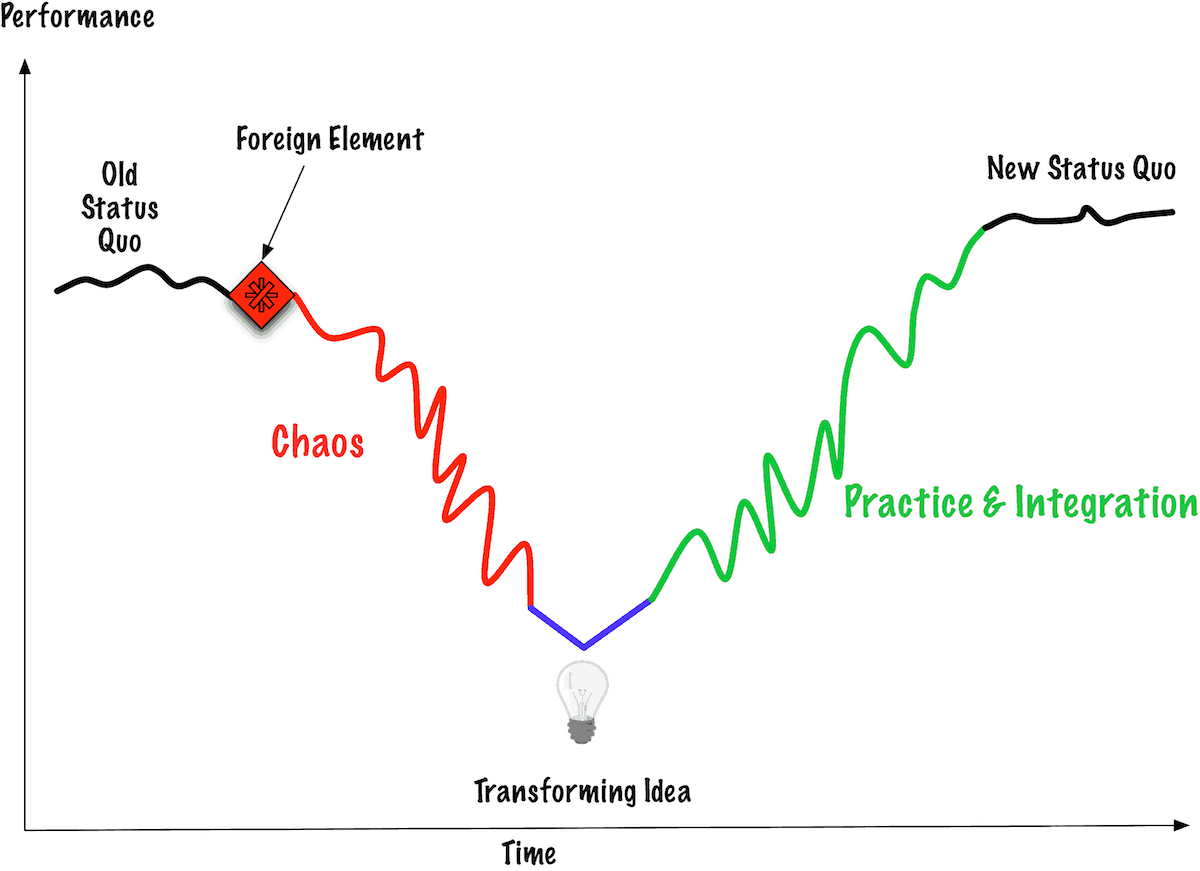
The bigger the problem, the larger the Foreign Element. That leads us to dread the “descent” into Chaos. Worse, we then doubt that we ever have a chance to even get to Practice and Integration. (See How Do You Manage When “Everything” Is In Chaos? for the details about the Change Model.)
No one has a “standard” reaction to Chaos, because it depends on the kind of Chaos we experience. Did we choose this change? I tend to be excited by that kind of Chaos. Did the change choose us? Yeah, I’m not so excited by externally-imposed Chaos.
I am an optimist, so it’s often easier for me to try something new. (Not because that thing is easy, but because I am not worried about making too many mistakes. That allows me the resilience and adaptability to try again if I fail.
But you don’t have to be a highly optimistic person to start new things and avoid the paralysis of starting. Instead, you can rely on the Progress Principle and the ideas behind deliberate practice to manage your possible failures, worries, or fear.
Progress Can Manage Fear
I write to learn what I think. That means that every time I write a new book, I make progress. Not just in my writing, but in my thinking. That’s a form of progress.
While you might not write, most of us love to make progress on whatever effort we start. (If you have not yet read Amabile and Kramer’s book The Progress Principle: Using Small Wins to Ignite Joy, Engagement, and Creativity at Work, I strongly recommend you do. That link is my Amazon affiliate link.)
Since I’m a list person, I add things to my list and mark them as done when I finish them. That means I can do many small things and feel joy when I “win” at finishing them.
That many small things and “win” idea is how we make progress.
But what about starting something new, especially if you have no idea how to start? Which practices help there?
Start as Small as Possible and Iterate with Practice
While you might want to use an LLM and ask it how to start, I prefer to start with the smallest possible step I can imagine. Here are some examples:
- For a book, write a blog post. Does that blog post interest me enough to write more? Or does it get interest from others? (To be honest, it’s hard to gauge other people’s interest these days, so I don’t bother. If I know three people who might need the value inside these posts or that potential book, I’ll keep writing.
- For a workshop, create a zeroth design. That design is good enough to offer value for the participants. It might not be everything I want to offer, but it’s enough.
- I am experimenting with using LLMs to see what they think. Remember, LLMs have old data, so they might not offer me new insights.
But the key to each “start small” is to add the iteration with practice.
The more we practice, the faster we can see our progress. The more we experience our various “wins.” That allows us to ease past that starting paralysis and move to something new.
My “process” for avoiding starting paralysis is:
- Acknowledge any fear.
- Look for progress made of small wins.
- Start small, as small as possible.
- Iterate to add more information.
This might work for you, too. Let me know if you try.