 How do you decide what to do next? Most of us find it quite tempting to continue whatever we have done, up until now. When we continue, we don’t need much adaptability or resilience. But what do you do when Something Happens?
That something might be wonderful, such as a lifecycle event, or when you host a large gathering for friends and/or family.
Or, that something might be terrible, such as losing your job. When Something Happens, we often need our adaptability and resilience to respond. Yet, too few of us realize how we can use that adaptability and resilience.
The image above shows the axes I use to see my adaptability and resilience as I make decisions. Or, as I realize I need to choose again.
How Adaptability and Resilience Work Together
Here’s another image I use as a way to check my adaptability and resilience:
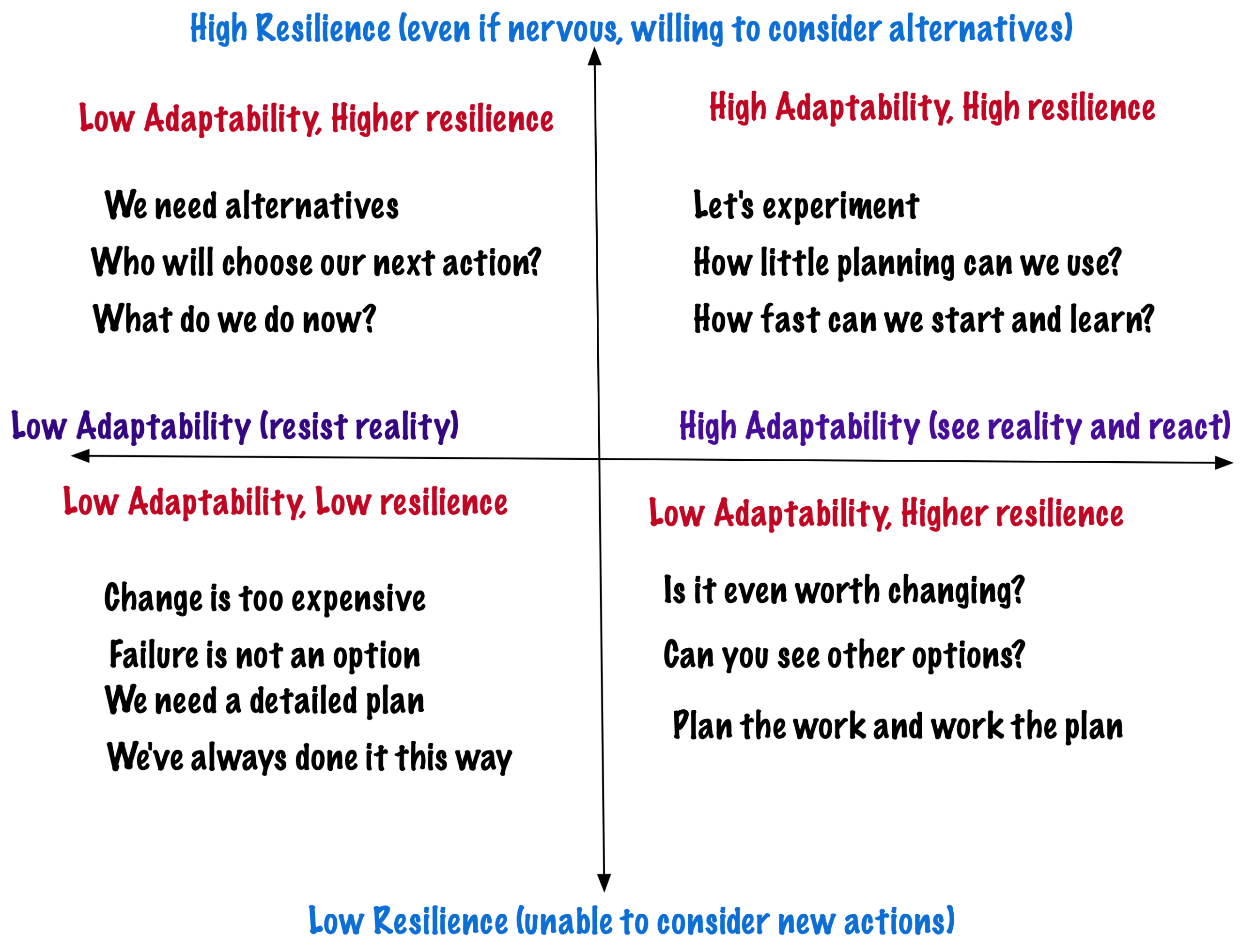
Sometimes, I hear myself saying, “I’ve always done it this way.” I know that I’m not using all my skills. Instead, I’m a little stuck in the lower left quadrant of low adaptability and low resilience.
Contrast that with moving up to the upper left quadrant. When we can say that we need alternatives, or that we question what to do now—that’s how we use our resilience, even if we are unsure.
Then, there’s the lower right quadrant, where we have lower adaptability, but higher resilience. We can see the need to change, but we try to contain the change. That’s why I put “Plan the work and work the plan” in this quadrant.
Finally, we have the upper-right quadrant, with the most adaptability and resilience. How can we experiment? How fast can we learn? What could we start with?
Now, let me discuss this in the context of decision-making, because that’s where I want to go this week.
All Decisions Reflect Adaptability and Resilience—Or Lack Thereof
Each decision is different and requires differing amounts of adaptability and resilience.
Imagine planning a dinner party for four to eight people. You have the menu and then go to the store to get all the ingredients. But the store does not have a key ingredient, such as asparagus. If you’re me, you delight in the missing asparagus, and go for some other green vegetable. Or, you decide to buy that dish from a caterer. Or you recreate the entire menu, this time without asparagus.
However, what if that dinner party was for twelve people? Or thirty? Now, you have a different size problem and might need to rethink all the decisions. Still, this is a relatively simple decision with many obvious options.
Some decisions have many fewer obvious options. One of those is managing the project portfolio, either for ourselves or for an organization. That’s because we have to choose what not to do, what to say No to.
Choose Early to Maximize Adaptability and Resilience
We might postpone those decisions to the “last responsible moment.” When is that “last” moment? Often, that is much earlier than people realize. For example, if the company is losing money, make decisions now, and start experimenting with possible revenue-generating possibilities. The longer the company waits for the “last” responsible moment, the more often that “last” moment is way too late.
Instead of choosing something else, they decide to “continue,” to “stay the course.” That “continue” decision is a function of low adaptability and low resilience.
That’s why early and frequent decision-making—even for small decisions—can help when you have big decisions to make. The more we practice our adaptability and resilience in small decisions, the easier it is to apply them to big decisions.
The first step, as always, is to see our reality to see how we decide.
That’s the question this week: How can you see your adaptability and resilience as you make decisions?