 How do you learn about how good your judgment is? If you’re like me, you might have learned some judgment unintentionally. You did something and it turned out well.
But I learn the most when I make mistakes. But only as long as I can see the consequences of that mistake and then examine those mistakes with double loop learning. (See Are You Too Busy to Continue Learning? for more details about what I mean by double loop learning.) I’m not fond of making mistakes. But I recognize the need to learn from them.
For example, early in my software career, I thought I had a four-week task. Four weeks into that task, I was 92% done. The following week I was 94% done. The next week I was all of 95% done. I continued for a couple more weeks until my manager took pity on me and explained about inch-pebbles. Ever since then, I’ve used inch-pebbles and checklists to clarify the work I need to do and to finish it.
Here’s what I learned to use better judgment later:
- The mistake was not realizing the tasks were more complex than I thought they were. That meant they would take longer to finish.
- The consequence: my estimate was way off. And I had no idea how to make a better estimate.
- With double-loop learning, I realized how to break tasks down much better.
- I can now choose where to apply those principles in my work.
All of that helped me build my project management expertise and use better judgment. In addition, I practice my estimation with various projects to build on that expertise.
My judgment comes from my practice and expertise. Not just one—both.
Judgment is a Function of Learning from Experience
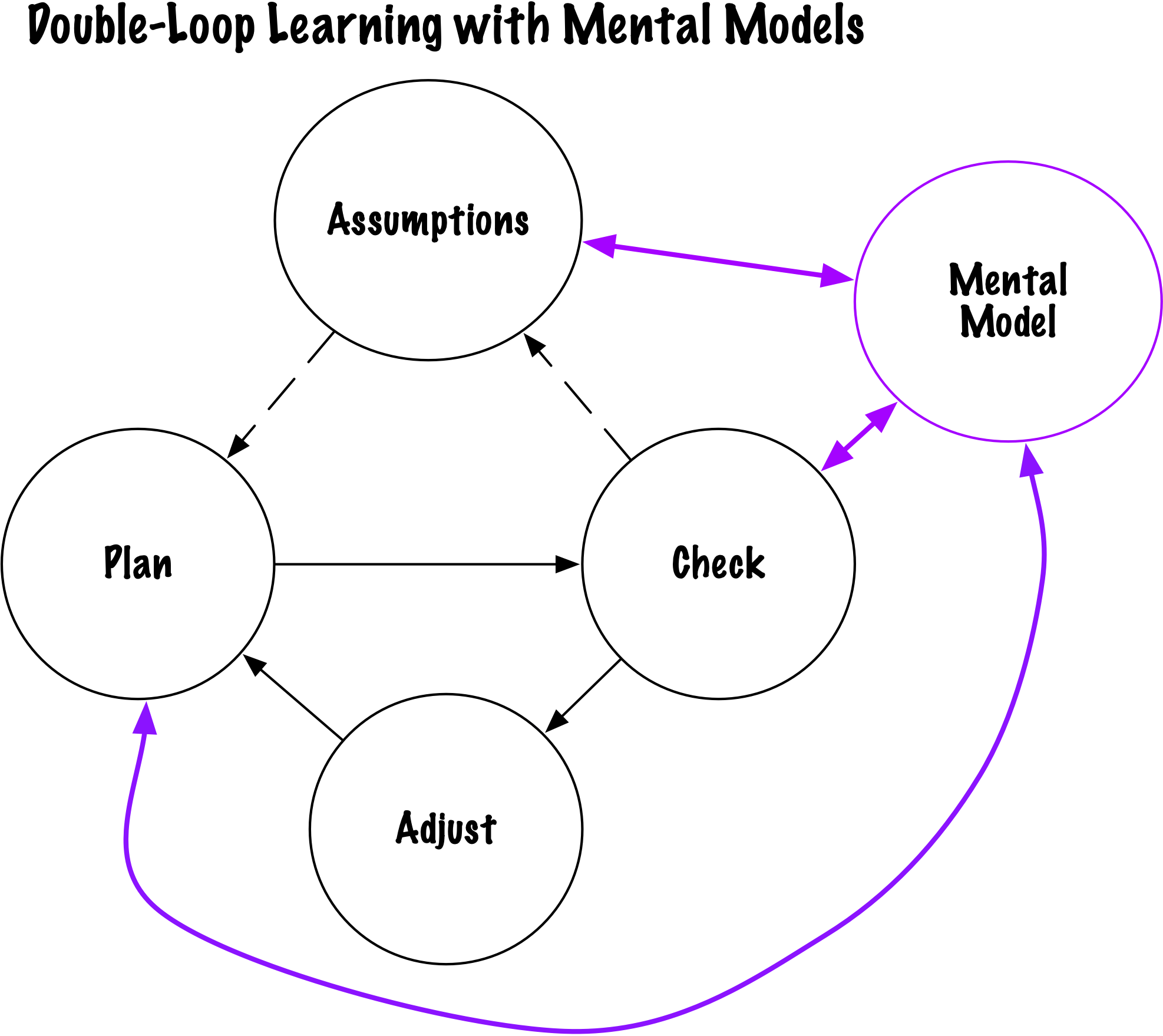
The more I practice anything, the more expertise I gain. When I first went low carb, I experimented with many recipes. I learned what worked for me and what did not. (My poor family also learned!)
The more I write and see what resonates with my various audiences, the more I learn what does and does not work about my writing. (That’s the same with my speaking, consulting, and workshops.) The audience feedback explains the consequences to me. Then, I can use double-loop learning to see what to adjust or where to experiment.
This is why I recommend against using the LLMs for writing. (I never use AI for writing. Even with chemo fog. Nope. Never.) We don’t know what we think until we write it down. And sometimes, we need to write it down several times to understand what we think. That’s okay.
When we experience the consequences of our decisions, we can learn from them. But we need both the experience and the consequence. Without those two, we can’t use double loop learning to learn better judgment. Once we have that learning, we can practice to reinforce that learning and judgment.
Choose where you want your expertise, and then practice with double-loop learning, so you can use your best judgment.