 I love learning about tools and how to use them. Here are some of the tools I use often:
- Manual tools I use in the kitchen.
- Electronic tools for my work, such as visualizing the flow of work, systems thinking models, as well as the tools I use to write and publish.
- Thinking tools, such as questions, research, and yes, AI models.
I have mastered my cooking tools and many of the electronic tools. However, I will not claim mastery of my research tools—that requires ongoing learning.
But that brings me to the problem of which tool to use when. What do I know about my current problem? Many interesting and complex problems require several tools to fix. That’s because we see signals or symptoms of problems—not the actual problem itself.
Questions can help me determine which tools make sense.
Choose Questions to Choose Tools
I rarely choose “why” questions. Mostly because we can’t possibly know the why now—or ever. Instead, I use context-free questions (see When Do You Go Meta? for examples). In addition, I ask these questions:
- What did I expect to see?
- What did I see that I did not expect?
- Based on those questions, is there any missing data that I can use for investigation?
Here’s an example from my work with teams. Technical teams deliver “too slowly.” The managers don’t deliver decisions “fast enough.” Everyone’s “too slow.” For these problems, I start with a value stream map. Then, I can ask questions about what I expected to see and what I did not expect to see? I might even ask questions about what’s missing. (See Unearthing Your Project’s Delays for an example.)
All of the visualizations and questions help me see the system that creates this problem. Or, more likely, this set of problems.
Now, I can choose how to experiment.
Tools Help Us Experiment and Learn
I wish I could solve all problems with “just” visualizations and questions. But that rarely happens. Instead, I need to experiment and learn.
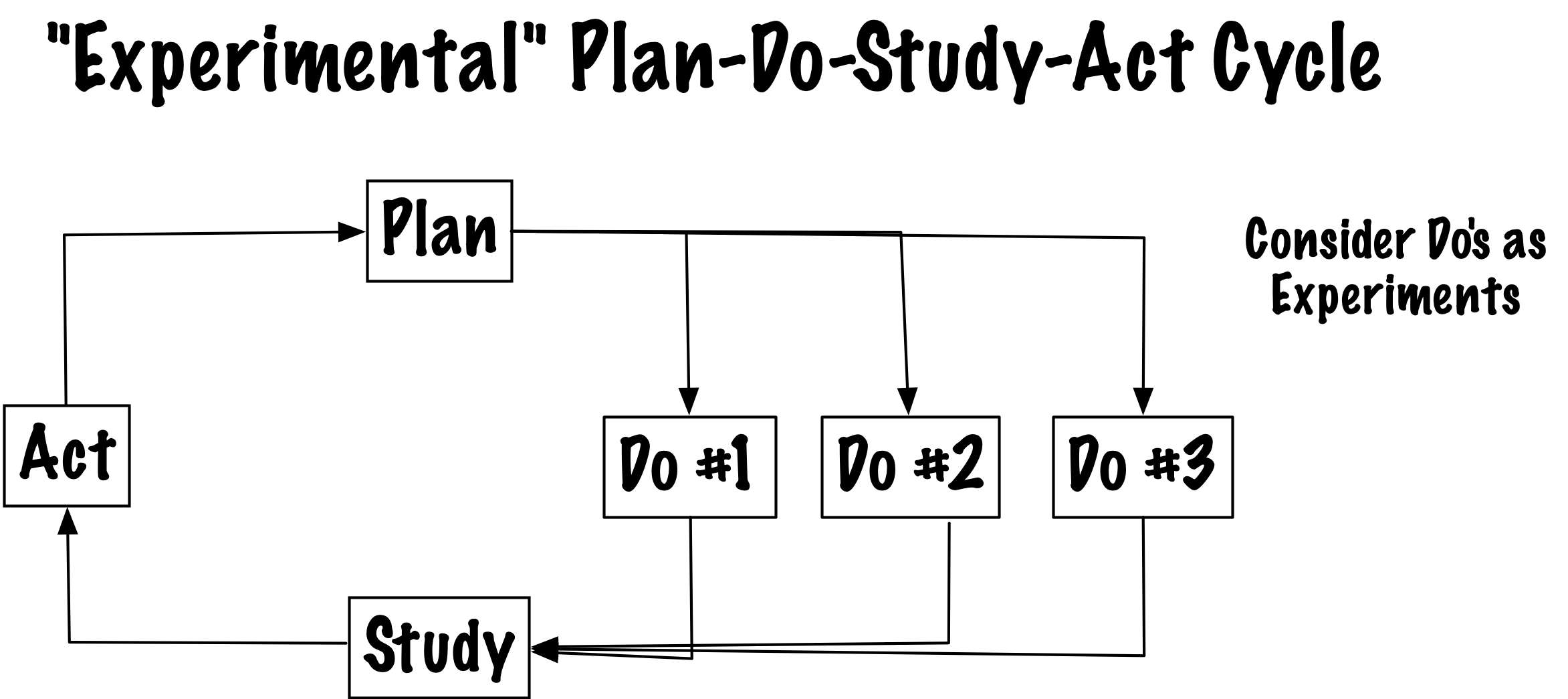 The “normal” Plan-Do-Study-Act cycle does not have the various “Do’s” as possible experiments. But I have learned that both my clients and I need to think more as experiments. Especially if we think our tools might have the “perfect” answer.
My kitchen tools often offer the perfect answer. That’s because I know any of my kitchen problems well. I have mastered them.
My electronic tools can offer many useful answers. But sometimes, those answers are incomplete. That’s why I need thinking tools.
While I have “mastered” many of the question and thinking tools, I have not yet “mastered” any of the AI tools. Yes, I use them a lot for research and for bouncing ideas back and forth. But no one has mastered them—not even the tool producers. (This is accurate as of late September 2026. This statement might not be accurate in the future!)
That’s why I like to experiment. How can I test my assumptions and the answers I get?
Learning Helps Me Choose Which Tools Are Right for This Problem
The less complex the problem, the more tools we have available. That includes the saying, “When all you have is a hammer, the world looks like a nail.”
But life rarely offers us obvious problems. Instead, life offers us juicy, complex, and challenging problems. That’s when I like to consider which tools—questions, visualizations, and experiments—will help us learn fast.
I don’t care if I don’t choose the “right” tool first. As long as I get there eventually. I hope you do, too.